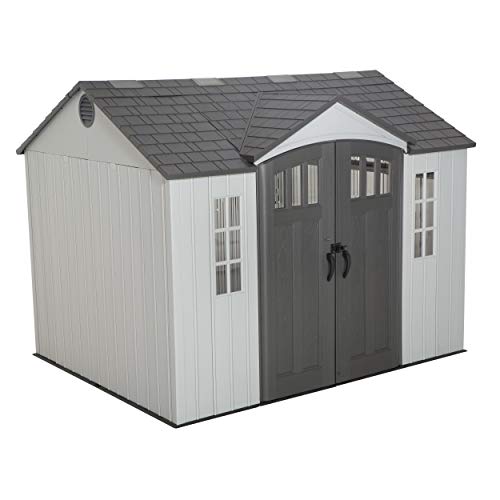
Best Lifetime pick (matched size) Lifetime 10×8 Ft. Outdoor Storage Shed $1,693.67 Check price on Amazon
Comparison
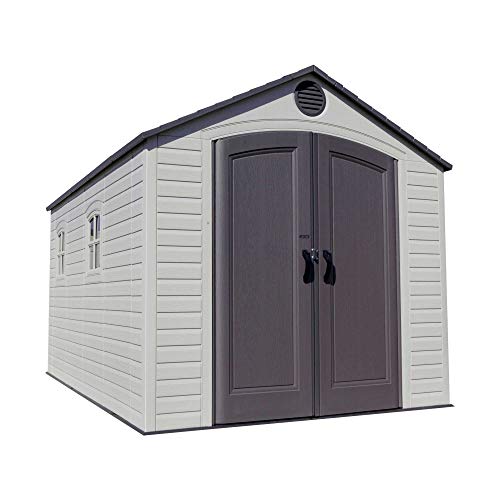
Matched size for size, the Lifetime 10x8 at $1,693.67 and the Suncast Tremont 8x10 at $1,599 both cover 80 square feet and both confirm a floor in the listing. Lifetime's version adds a skylight and screened vents; Suncast's is the slightly cheaper of the two per square foot.
| Lifetime 10x8 | Suncast Tremont 8x10 | |
|---|---|---|
| Footprint | 80 sq ft | 80 sq ft |
| Price per sq ft | about $21.17 | about $19.99 |
| Floor confirmed in title | Yes, slip-resistant floor | Yes, floor included |
| Skylight | Yes, listed | Yes, listed |
| Ventilation | Screened vents, listed | Not called out in the title checked |
| Doors | Side-entry doors with windows | Lockable double doors |
| Shelving | Adjustable shelves listed | Not called out in the title checked |
| Wall construction | Dual-wall HDPE, steel-reinforced | Resin, dual-wall |
| Best for | Buyers who want the longer confirmed feature list | Buyers prioritizing a slightly lower price per square foot |


Prices change often; the button shows today's price on Amazon.
Closer than most head-to-head shed comparisons. The Lifetime 10x8 at $1,693.67 and the Suncast Tremont 8x10 at $1,599 both cover exactly 80 square feet, both explicitly confirm a floor in their listing, and both land in the same general price tier. Lifetime's listing runs a slightly longer confirmed feature list: adjustable shelves and screened vents in addition to the skylight and windows both sheds share. Suncast's runs about a dollar and change less per square foot.
At about $21.17 a square foot, the Lifetime pick includes side-entry doors with windows, a skylight, screened vents, and adjustable shelves, all stated directly in the listing. At about $19.99 a square foot, the Suncast Tremont includes a floor, lockable double doors, and skylights, per its own listing, but does not call out shelving or screened ventilation the same way. If shelving and active ventilation matter to you, the Lifetime pick's extra dollar or two a square foot buys those features outright rather than requiring separate accessory purchases later.
Yes, once you look past this one matched comparison, the lineups diverge. Lifetime scales up to genuinely large structures, including the 8x15 model at $1,854, about $15.45 a square foot, close to workshop territory. Suncast leans more toward compact, styled options, like the 6x5 Modernist at $1,039.99, which does not confirm a floor in its title, so verify that on the spec page if you go smaller with Suncast. If you need a genuinely large shed, check Lifetime's larger sizes first; if you want a smaller shed with a more architectural look, Suncast's Modernist line is worth a look, floor detail permitting.
No, both are dual-wall resin construction and neither brand changes the underlying math. A shed's roof load runs about 0.67 times your local ground snow load before slope reduction, using the ASCE 7 method for an unheated, low-risk structure, regardless of brand. Anchoring is identical too: one anchor at every corner minimum and one every 6 to 8 feet along long walls. A confirmed floor on either brand does not substitute for anchoring in high wind.
Nothing here was assembled or tested by hand. These picks come from the exact wording published in each Amazon listing and recurring patterns in verified owner reviews for both brands, matched here specifically at the same footprint so the comparison is genuinely apples to apples.
Both use dual-wall resin panel construction, and several Lifetime models add internal steel reinforcement, per their listings. The two brands are close enough in build approach that, size for size, the differences show up more in included features like shelving and ventilation than in the core wall material.
In the matched 80 square foot comparison here, Suncast's Tremont runs about $19.99 a square foot against Lifetime's roughly $21.17, a difference of a little over a dollar a square foot. That gap can flip at other sizes, so always compare the specific models and footprints you are actually considering rather than assuming one brand is cheaper across the board.
Not in this catalog. Lifetime's largest models run up to 8 by 20 feet, closer to workshop scale, while Suncast's lineup here tops out smaller, closer to 8 by 13 feet on its largest Tremont model. If you need genuinely large square footage, check Lifetime's upper sizes first.
Based on the listings compared here, the Lifetime 10x8 states more included features directly in its title, specifically adjustable shelves and screened vents alongside the skylight both sheds share. That does not mean Suncast models never include these; check each specific listing rather than generalizing across either brand's full lineup.
No. The matched 8x10 models compared here both confirm a floor, but smaller models in either lineup do not always state this in the title. Always check the specific listing or spec page for the model you are considering rather than assuming floor inclusion carries across an entire brand's lineup.
This page is researched guidance, not professional engineering, legal or building-code advice. Sizes, loads and permit rules vary by product and by town: check your local code and the kit manufacturer's instructions before you build.